 MeshSafe-CAN built to order in Australia
One e-stop stops every machine in the group.
MeshSafe Site Stop links separate machines into one emergency stop group by radio. There is no site stop cable to run, protect or re-run when the machines move.
Every machine keeps an e-stop within reach; a radio stop from another machine is never the only one.
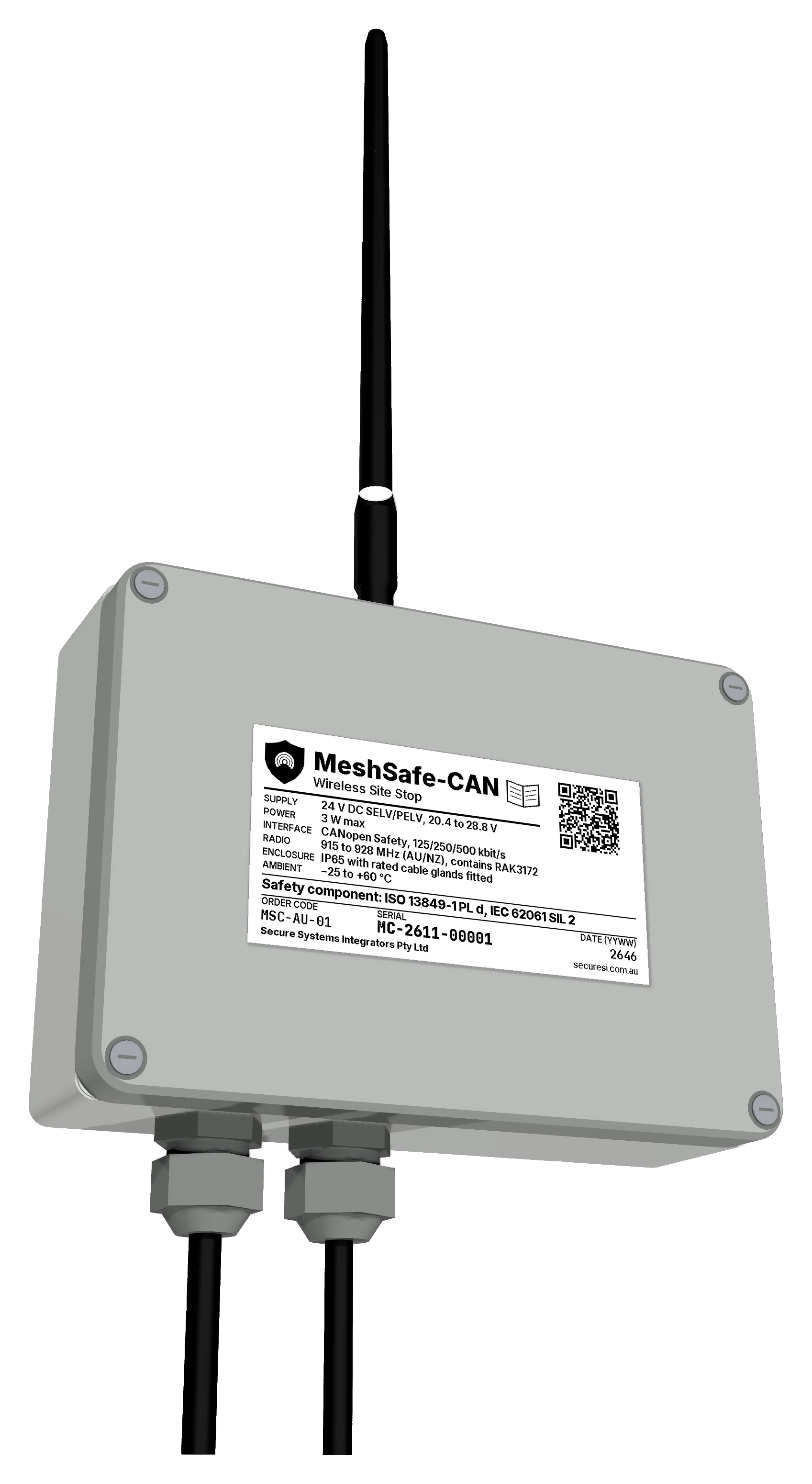
Design render, enclosure as specified.
A site stop without the cable
Each machine gets one MeshSafe unit. The units find each other by radio. There is no trench, no cable tray and no cable to damage.
If a unit goes quiet, the group stops
Every unit reports ten times a second. If an e-stop station cannot be heard for longer than its allowance, every machine in the group stops. Silence is treated as a stop.
No single point of failure in the link
There is no master and no base station. Every unit relays for the others, so a unit without line of sight to another reaches it through a neighbour.
Reset stays with the machine
Nothing restarts on its own. When the cause is cleared, each machine still needs its normal manual reset at its own safety controller.
Built as a safety device
Two independent safety channels, each with its own supply and supervision, running separately developed firmware.
Safety level
Declared PL d (ISO 13849-1) and SIL 2 (IEC 62061), self-declared. Hardware engineered to PL e / SIL 3, pending certification.
How it works
MeshSafe does one job, and treats silence as a stop.
Press an e-stop. That machine's safety PLC tells its unit, the unit tells the group, and every other unit tells its own machine's safety PLC to stop.
Lose a unit. If an e-stop station isn't heard for longer than its allowance, every machine stops, within 400 ms on a direct link.
Release and reset. MeshSafe never restarts a machine. Each one waits for its normal manual reset at its own safety controller.
Try it on the panel: tap any machine to press its e-stop.
- t=0Group healthy: 8 units, 10 updates/s each
Design values, shown at ¼ speed: about 120 ms on a direct link, lost unit within 400 ms, about 100 ms more per relaying unit.
In three steps
Fit, group, stop.
- 1
Fit a unit to each machine.
MeshSafe-CAN connects to the machine's CANopen Safety PLC with a 24 V supply and a CAN cable.
- 2
Join the units into a group.
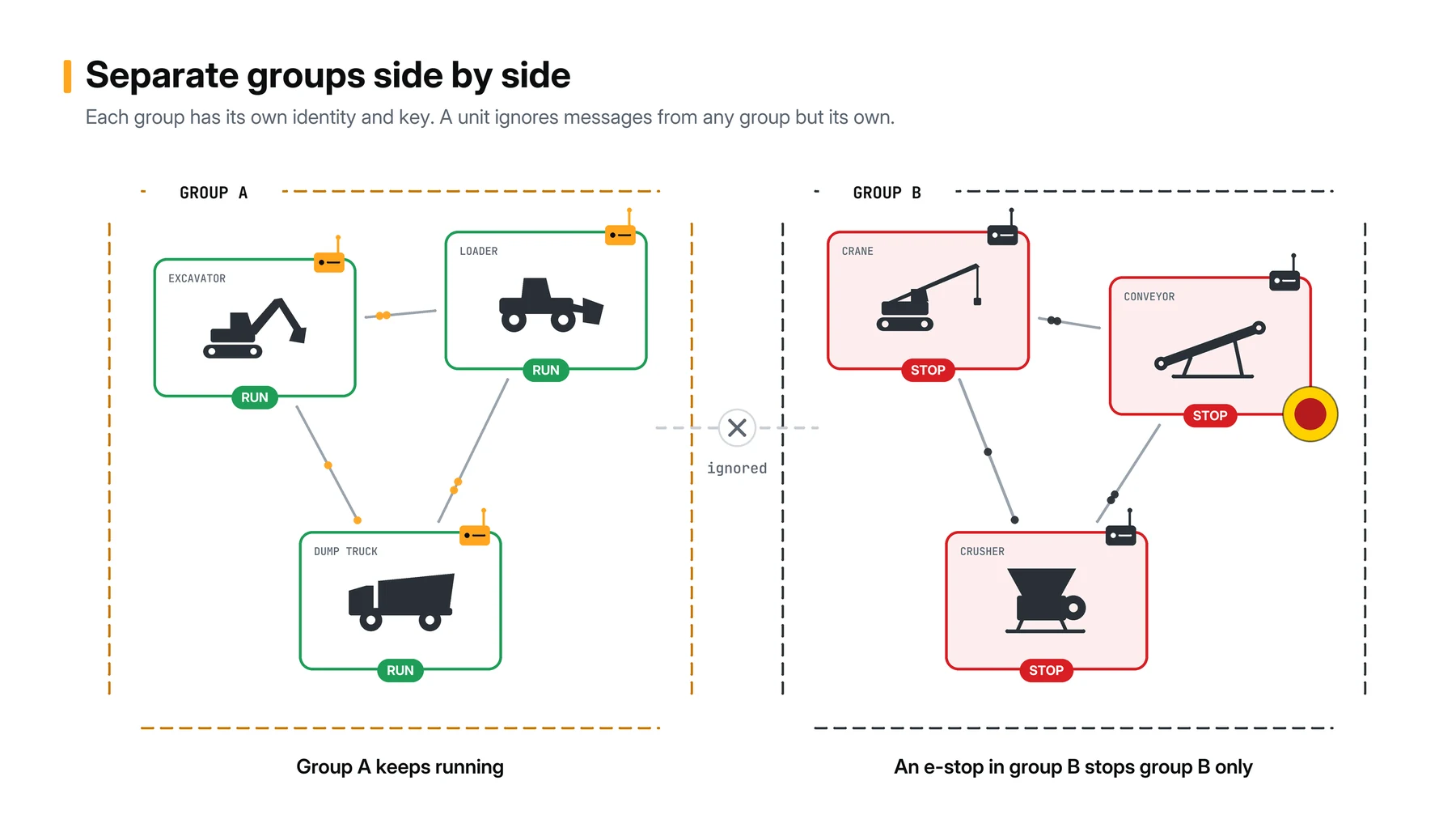
Each group has its own identity and key. Units outside the group are ignored.
- 3
Press any e-stop.
Every machine in the group gets a stop from its own safety PLC. Release the e-stop, then reset each machine in the normal way.
Watch a group stop, and reset.
Six machines, one e-stop. Every machine stops, each is reset by hand, and when one unit is no longer heard, every machine stops again.
Mesh relaying
No master, no base station, no fixed route.
Every unit relays the latest state it holds for every other unit. If two units can't hear each other directly, the message goes through a neighbour, with up to three relaying units between any two units.
When machines move and the radio path changes, the group carries on. A change of path is not a reason to stop.
Separate groups
One group can't stop another.
Each group has its own identity and key, every message is authenticated, and messages from other groups are ignored.
Groups that share a site also share the radio band, so tell us how many groups you plan and we'll set them up to stay clear of each other.
The range
One safety core, two ways to connect to the machine.
Both units share the safety core, radio and enclosure, so they can be mixed freely in one group. Only the connection to the machine differs.
MeshSafe-CAN
Built to order · 3–4 weeksFor machines with a CANopen Safety PLC.
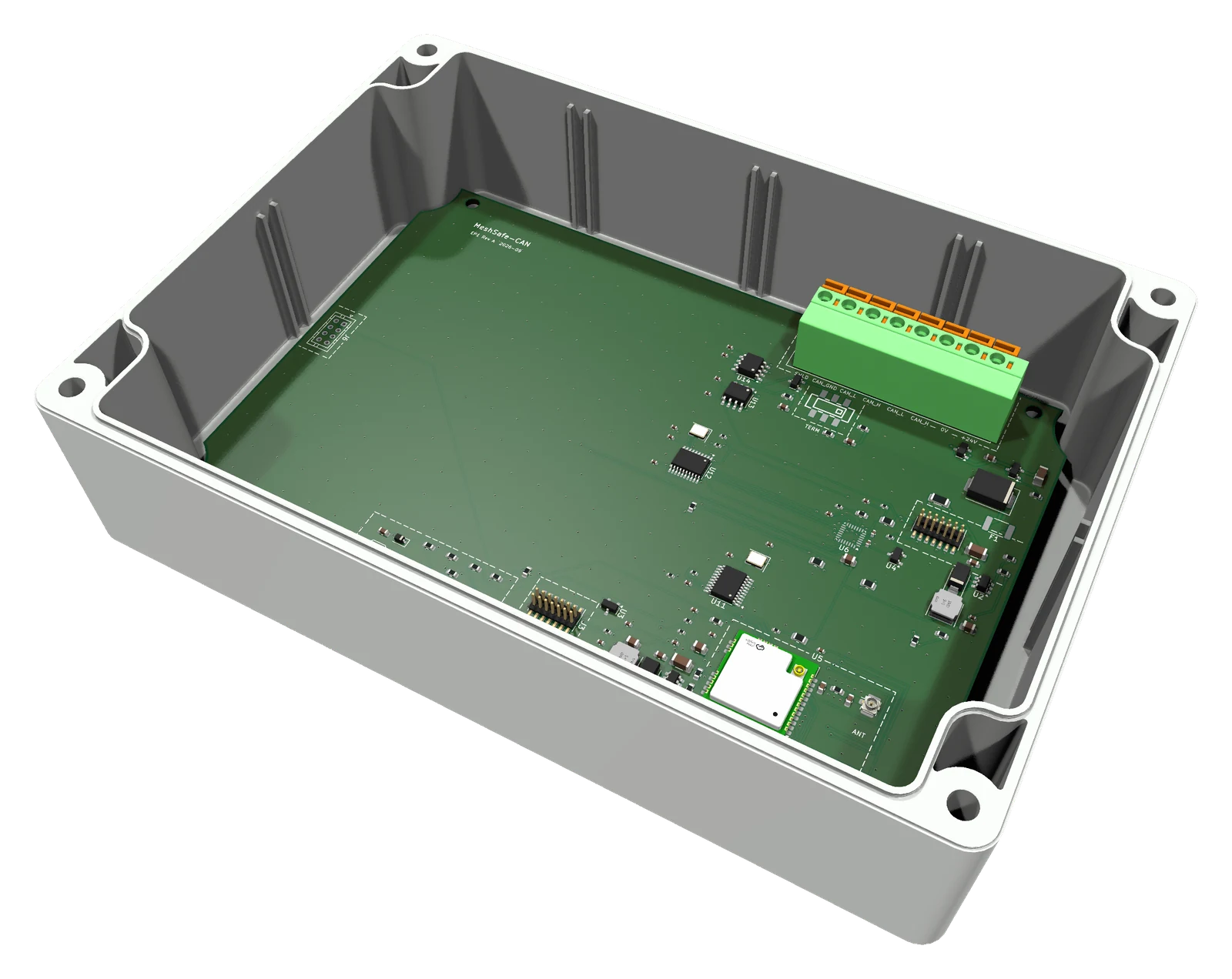
Connects directly to the machine's safety PLC over CANopen Safety. There is no relay interfacing and nothing is added to the e-stop wiring. The PLC treats the group stop like any other safety input, with CANopen Safety's own timing and integrity checks on top of ours.
MeshSafe I/O
Coming nextFor machines with a safety relay or plain e-stop wiring.
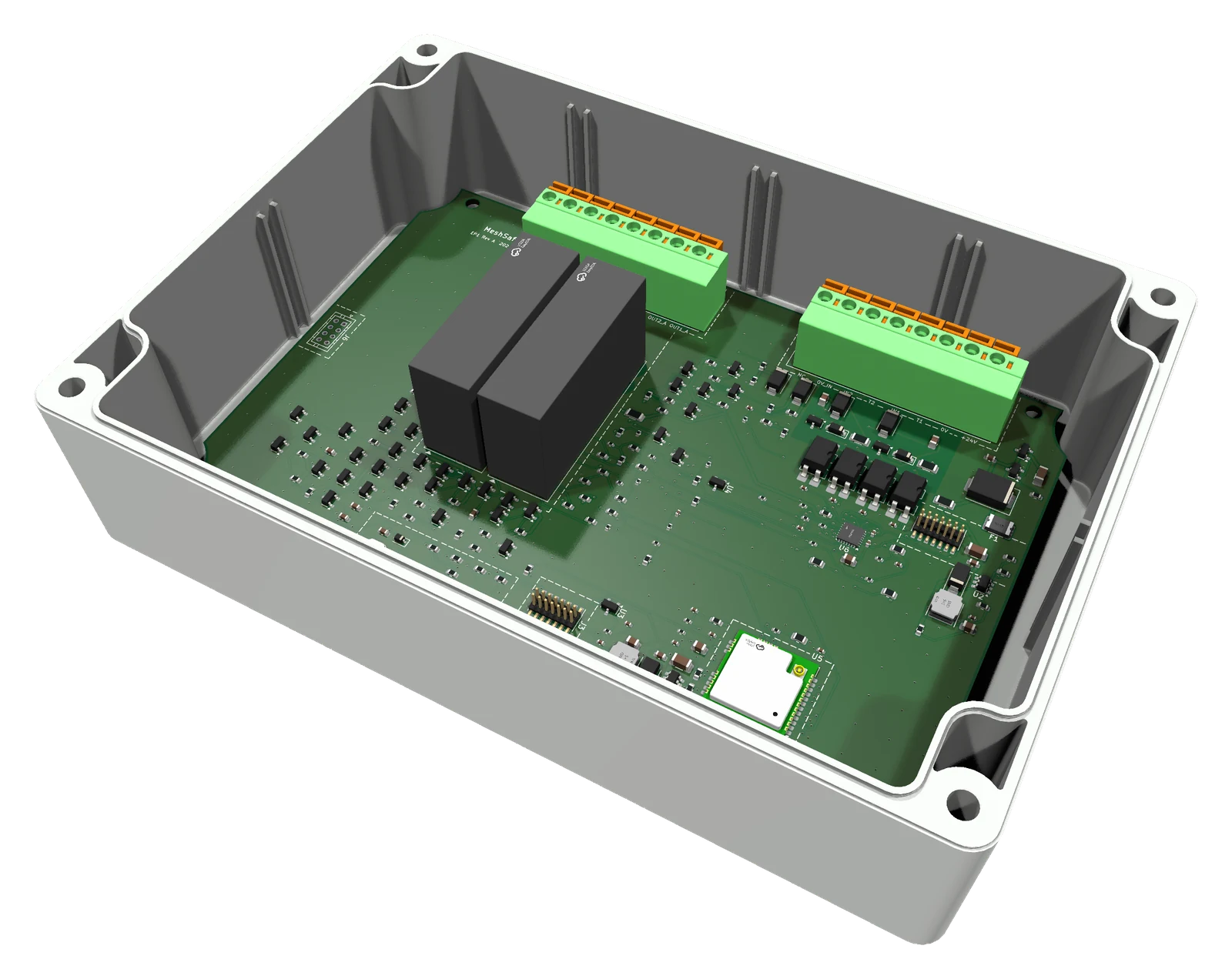
- Two isolated 24 V safety inputs read the machine's own e-stop state.
- Force-guided relay contacts sit in series with the e-stop circuit and open on a group stop.
- Outputs for 24 VDC control circuits; other voltages through an interposing relay.
- A plain e-stop button wired to a unit makes a standalone e-stop station.
MeshSafe I/O (order code MSI-AU-01) is designed and is not yet in production. It follows MeshSafe-CAN. We don't have a delivery date yet.
MeshSafe-CAN
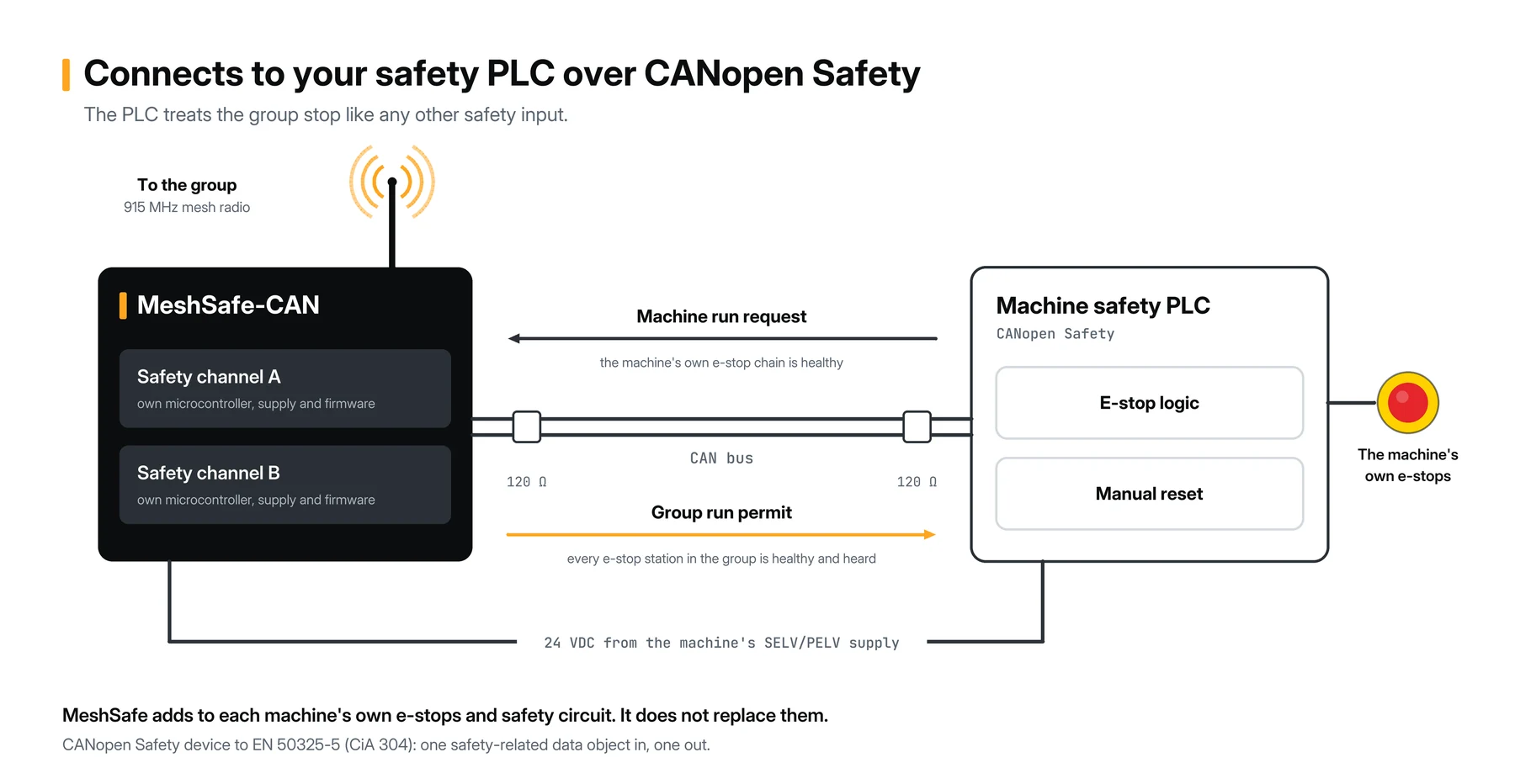
How it connects to a CANopen Safety PLC.
A CANopen Safety device to EN 50325-5 (CiA 304), exchanging two safety-related data objects with the PLC.
- Machine run request
- PLC to MeshSafe: the machine's own e-stop chain is healthy.
- Group run permit
- MeshSafe to PLC: every e-stop station in the group is healthy and heard.
If the permit drops, is late, is corrupt or goes missing, the PLC goes to its safe state. Setting up is standard CANopen work: import the supplied EDS file, set the node-ID with the service tool, and wire 24 V, 0 V, CAN high and CAN low plus the shield.
Safety
A safety product should say exactly what it claims.
Declared PL d (ISO 13849-1) and SIL 2 (IEC 62061), self-declared. Hardware engineered to PL e / SIL 3, pending certification.
The declared level is the one we stand behind today: PL d to ISO 13849-1 and SIL 2 to IEC 62061, both self-declared. The hardware is a Category 4 architecture, engineered to PL e / SIL 3, pending certification, so a later move to the higher level is a matter of validation, documentation and certification, not a redesign.
For MeshSafe-CAN the probability of a dangerous failure per hour (PFHd) is 2.66 × 10⁻⁹ per unit, calculated (ISO 13849-1 / IEC 62061 method), pending certification, for use in your own performance level calculation. The datasheet sets out the safety-related figures and their status.
The design also follows
- ISO 13850 for the emergency stop function
- IEC 60204-1 for cableless control: stop on loss of communication, link indication, warning before the link degrades
- IEC 62745 for cableless control systems of machinery
- EN 50325-5 (CiA 304) for the CANopen Safety interface
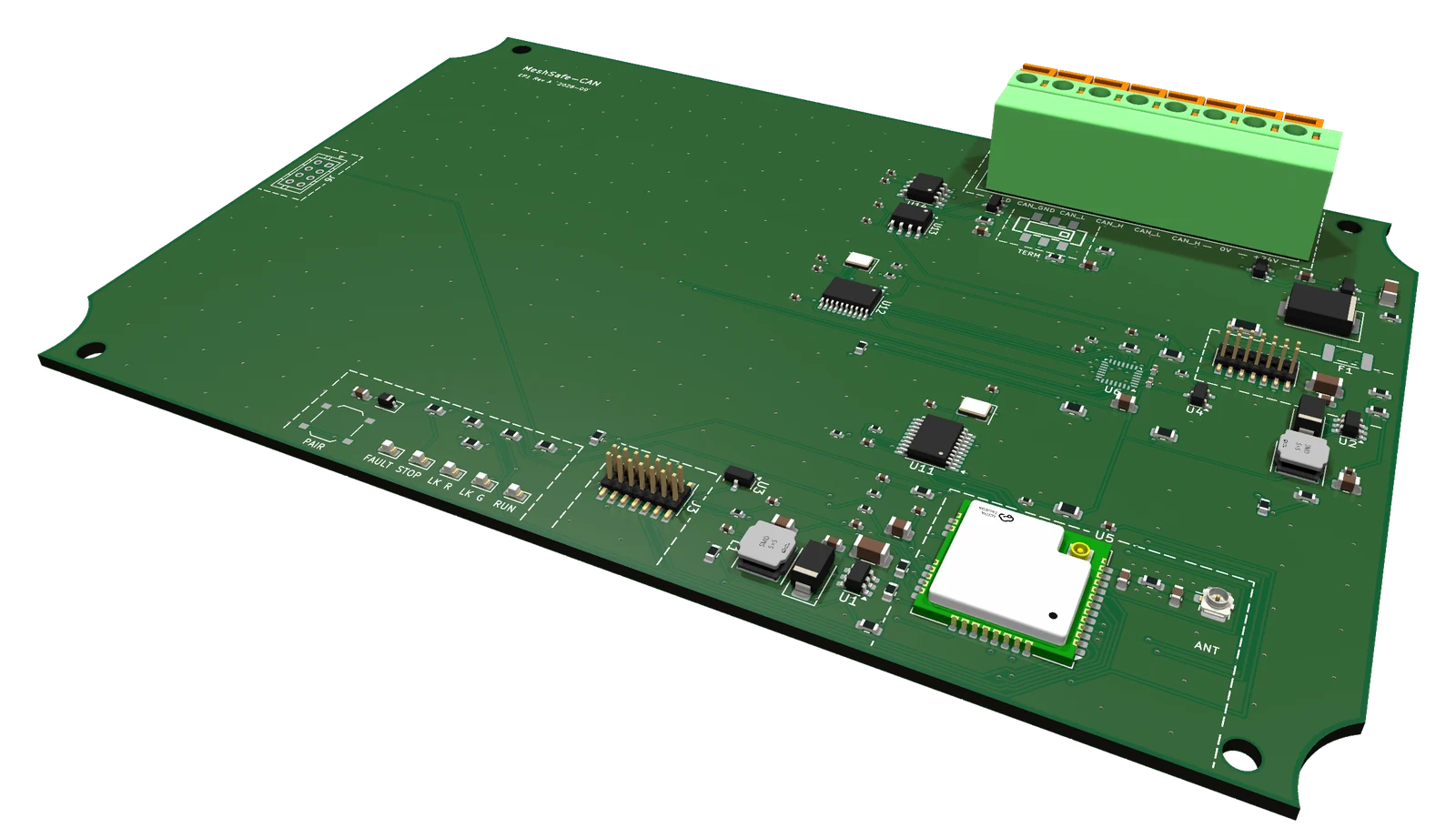
Two independent safety channels
Each with its own supply and supervision, running separately developed firmware. Neither channel can signal "run" on its own. If they disagree, the unit stops.
Every radio message checked by both channels
A message does not go on air until both channels agree on it, and a received message is checked by both before either acts on it.
Authenticated radio link
Every message is authenticated and integrity-checked. Messages from outside the group, corrupted messages and replayed messages are rejected.
Continuous self-tests
Each channel tests its processor, memory and program while it runs, and checks the other channel's supply. A detected fault puts the unit into stop and the group stops with it.
Signed firmware
Each channel verifies the firmware's digital signature independently before it runs. An update has to be confirmed by someone at the unit.
Nuisance trips treated as a safety problem
Operators bypass a site stop that trips for no reason. Short, self-clearing events are handled separately from real faults, which latch until someone clears them.
What MeshSafe is
- An additional emergency stop measure that links machines into a group.
- A device that fails to stop: loss of power, loss of radio and internal faults all lead to a stop.
- A component in your safety system. The integrator adds its response time to each machine's own stopping time in the risk assessment.
What MeshSafe is not
- It is not a stop that may be any machine's only means of emergency stop when received by radio from another machine.
- It is not a reset: reset stays manual at each machine.
- It is not a machine control or a start signal. It can only take the run permit away.
- It is not for hazardous (explosive atmosphere) areas.
MeshSafe-CAN
Key specifications.
Response times and range are design values. The first bench measurements agree with them, and field range tests are in progress. The full figures and their status are in the datasheet.
| Order code | MSC-AU-01 (Australia and New Zealand) |
|---|---|
| Machine interface | CANopen Safety (EN 50325-5 / CiA 304): one SRDO in, one SRDO out |
| CAN bit rates | 125, 250 and 500 kbit/s. Factory setting 500 kbit/s |
| Node-ID | Set with the service tool (LSS). Factory setting 32. Use node-IDs 1 to 32 |
| Bus termination | External: a 120 ohm resistor at each end of the bus |
| Group size | 2 to 20 units. Several separate groups can work on one site |
| Radio band | 915 to 928 MHz (Australia and New Zealand) |
| Radio link | Mesh radio, every unit relays. 10 updates a second from every unit |
| Transmit power | Adjustable up to +22 dBm conducted |
| Relaying | Every unit relays. Up to 3 relaying units between any two units |
| Range | Designed for 200 m between units with the standard antenna |
| Stop time, radio path | About 120 ms from a stop at one unit to the stop decision at another, direct link. Each relaying unit adds about 100 ms |
| Loss of a unit | Detected and acted on within 400 ms, direct link |
| Safety design | Two independent safety channels, Category 4 architecture |
| Safety level | Declared PL d (ISO 13849-1) and SIL 2 (IEC 62061), self-declared. Hardware engineered to PL e / SIL 3, pending certification. |
| Firmware | Digitally signed. Updated over the CAN bus and confirmed at the unit |
| Supply | 24 VDC nominal (20.4 to 28.8 VDC) from the machine's SELV/PELV supply |
| Enclosure | Polycarbonate, IP65 rated by its manufacturer when fitted with suitable cable glands. 171 × 121 × 55 mm, with mounting flanges |
| Connections | Push-in terminals for 0.2 to 1.5 mm² wire, through cable glands |
| Antenna | External 915 MHz whip on an SMA connector. It can be extended outside a metal cabinet |
| Indicators and controls | RUN, STOP, FAULT and two LINK LEDs. One recessed PAIR button. No reset button |
| Operating temperature | Designed for -25 °C to +60 °C |
| Wearing parts | None |
Service tool
Set up and maintained over the CAN bus.
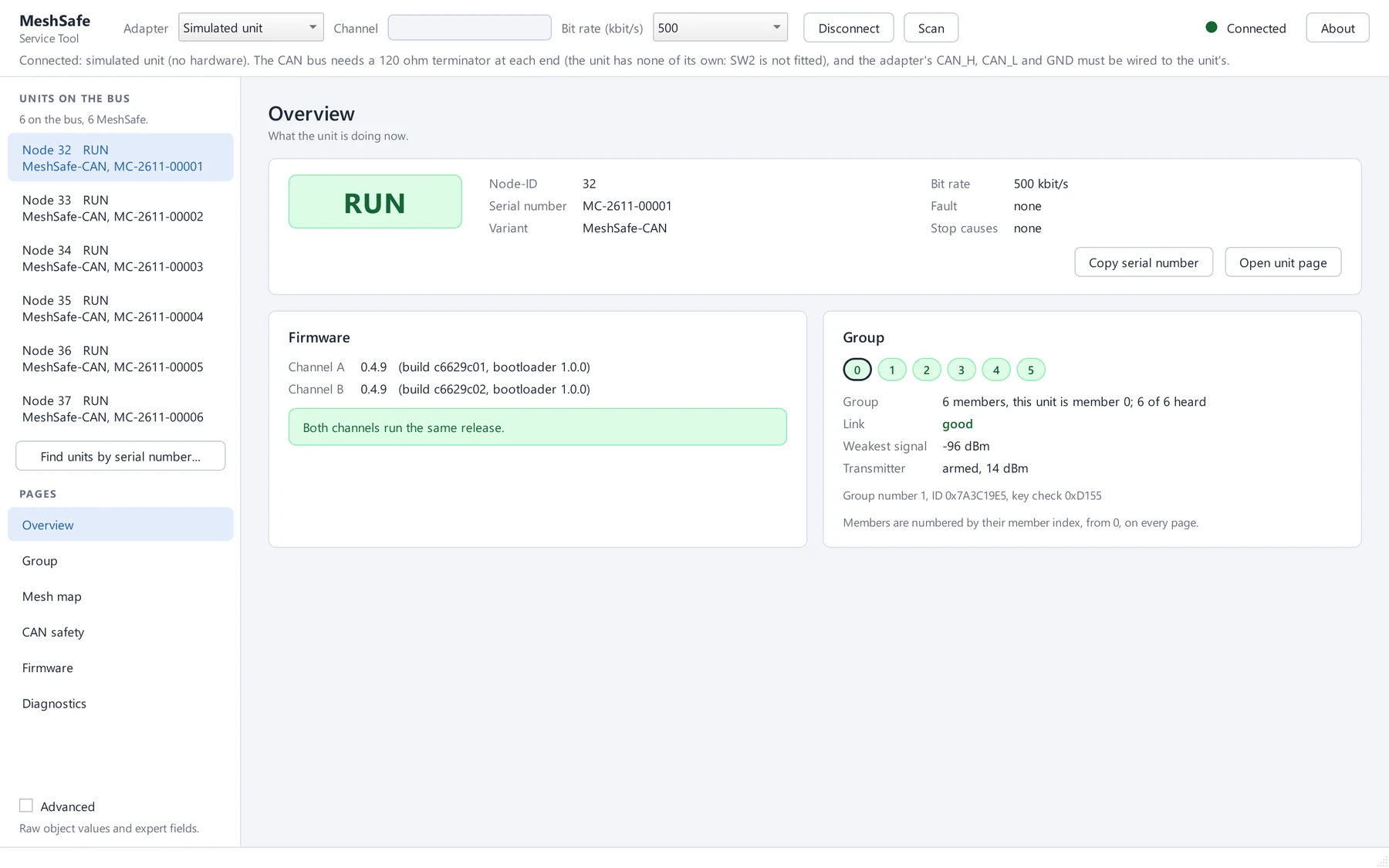
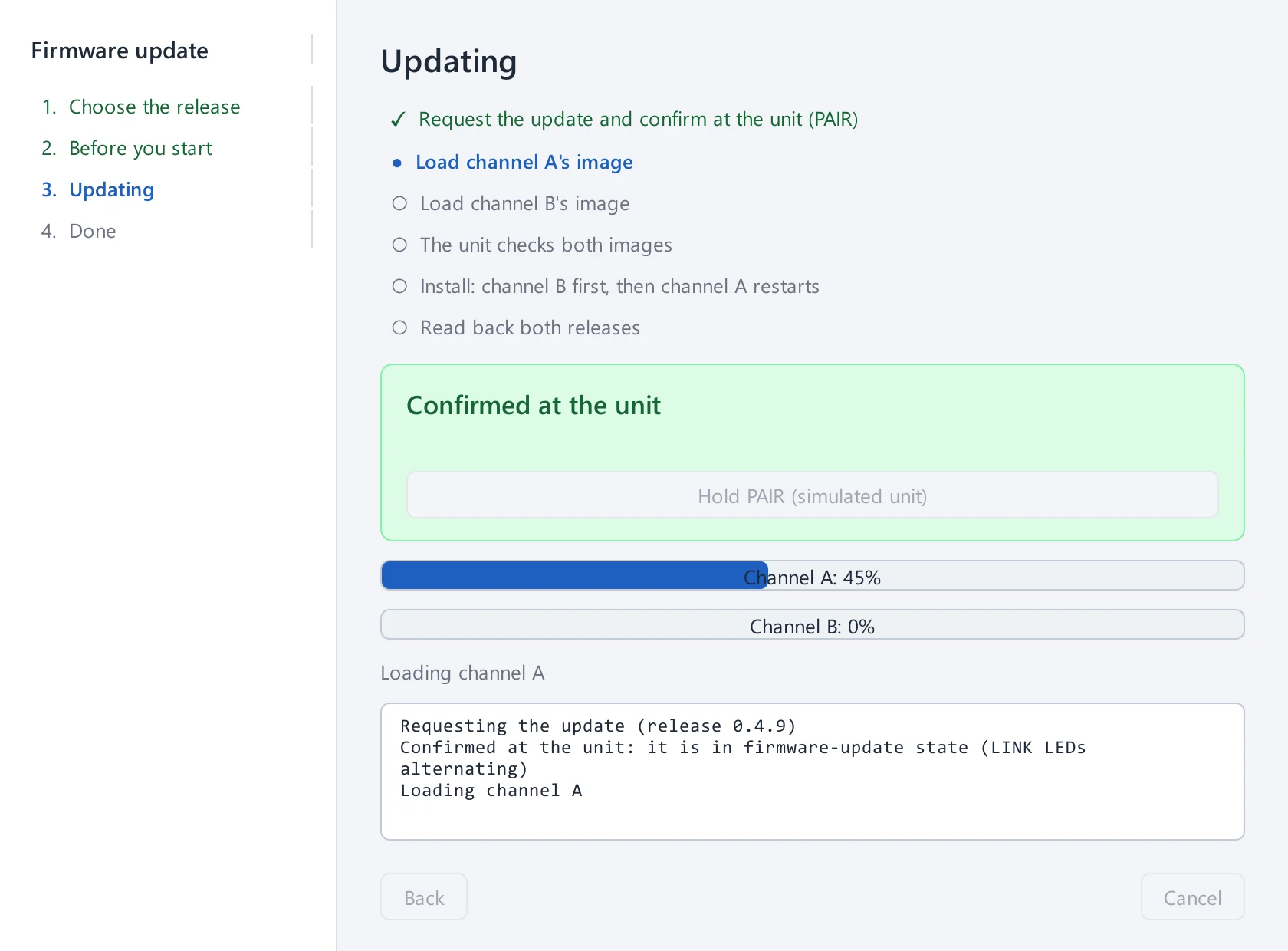
The MeshSafe Service Tool for Windows shows each unit's state, fault history and radio link quality. It sets the node-ID and bit rate and loads signed firmware updates. Any change that matters to safety has to be confirmed by someone at the unit.
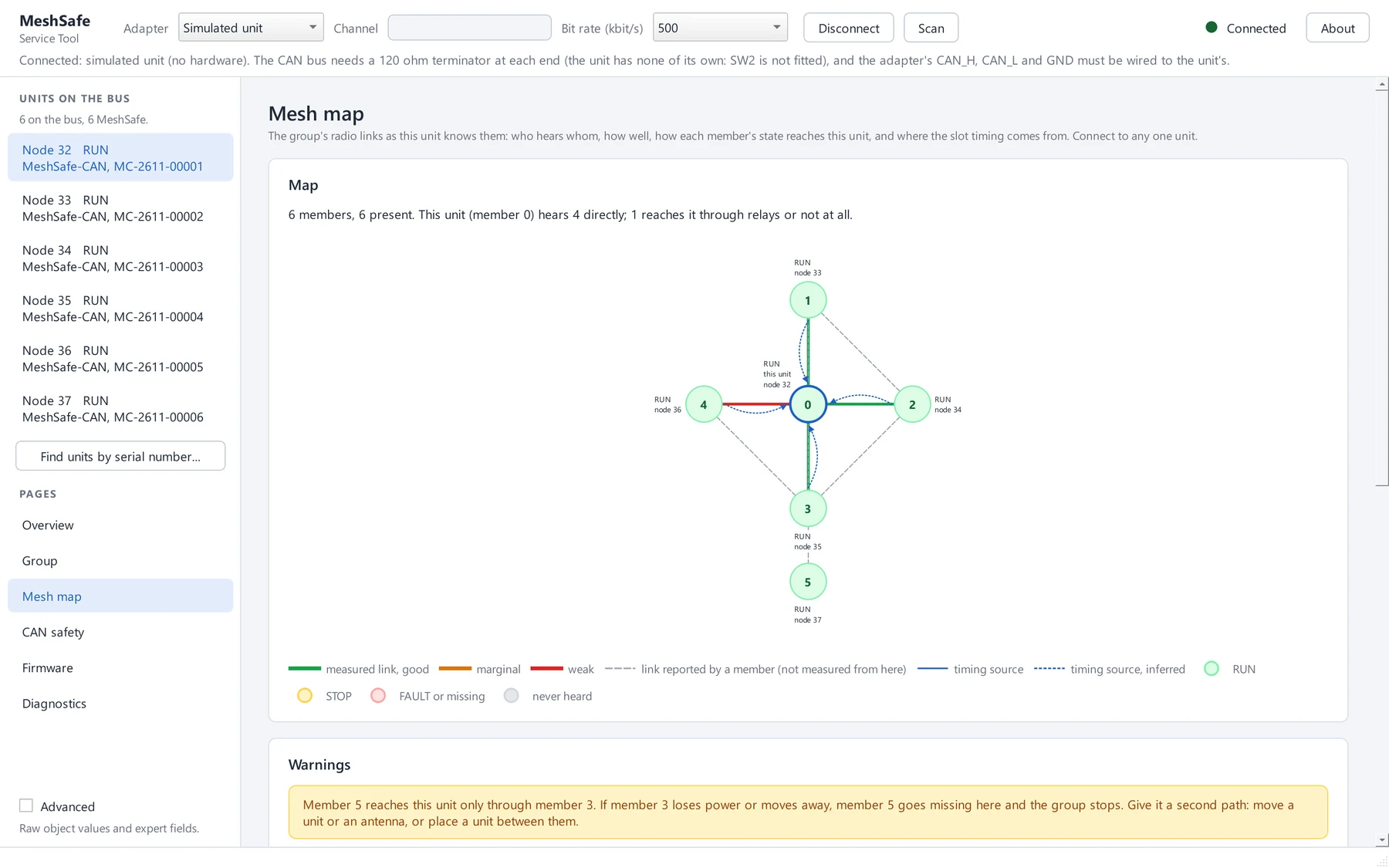
See the whole group at once.
The mesh map is a live map of the group: every unit, every direct radio link and its signal strength where measured, how each unit is reached, and plain-language warnings, such as a unit that can only be reached through one relay.
What's in the box
- The MeshSafe-CAN unit in its enclosure, with the antenna connector fitted
- A 915 MHz whip antenna
- Rating and identification label
- Operating Instructions
- Software: the MeshSafe Service Tool, the EDS file and signed firmware release packages
You provide
A 24 VDC SELV/PELV supply, cable glands rated IP65 or better (the enclosure is supplied undrilled), shielded 120 ohm CAN cable with a terminator at each end, M4 fixings, and a USB-CAN adapter for the service tool (Kvaser, PEAK and IXXAT adapters are supported).
Downloads
Everything you need to choose, design in and commission.
The EDS file for your PLC tool, and a 3D model and dimension drawing of the unit for your machine design. The datasheet, operating instructions and service tool guide are available on request.
CAD models are modelled by Secure Systems Integrators from published dimensions and are free to use for integrating MeshSafe into your designs.
- EDS file (firmware 0.4.8)CANopen electronic data sheet for your safety PLC's configuration tool.EDS27 KB
- 3D model, MSC-AU-01Exterior model with flanges, mounting holes, antenna and glands (mm).STEP470 KB
- 3D model with clearancesAs above, with recommended clearance zones for cable bends and the antenna.STEP505 KB
- Dimension drawingOutline, mounting hole pattern and gland and antenna positions.PDF7 KB
Documents on request
More detail for integrators.
- MS-SAL-001Technical overview
- MS-DVM-002Device manual and object dictionary
- Release notesFirmware release notes
- Safety analysisBasis of the declared level
Questions
Can MeshSafe be a machine's e-stop circuit?
How fast is it?
What happens if the radio drops out?
What is the range?
Can someone stop my site, or stop it from stopping, with a radio?
Which PLCs does it work with?
A machine comes and goes from my site. Will it stop the others when it leaves?
Is it certified?
How much does it cost?
Where is it available, and what is the lead time?
Building the first sites now.
MeshSafe-CAN is the first release. It is built to order in Australia with a lead time of 3 to 4 weeks. Tell us about your machines and we will tell you plainly whether MeshSafe suits them.